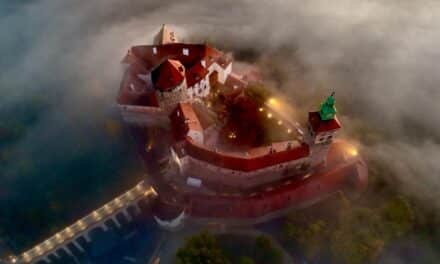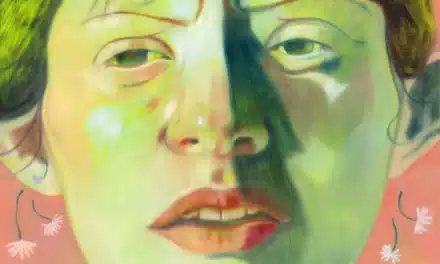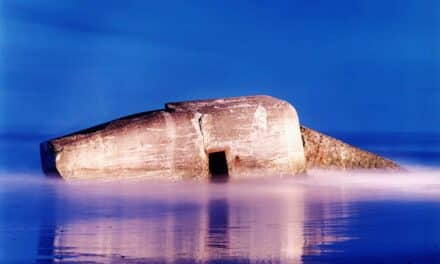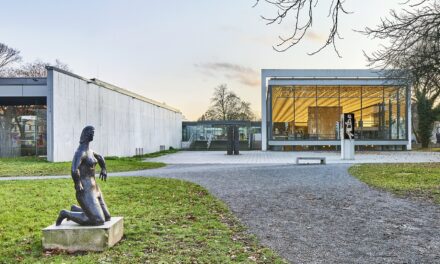
With an innovative reinterpretation of the traditional provincial exhibitions, STEIERMARK SCHAU stages socially significant topics from an artistic and scientific perspective every two years. The format, which was launched by the Province of Styria in 2021, is also being realized in its third edition by the Universalmuseum Joanneum. After the first edition focused on the development, identity and future of Styria, the second edition in 2023 explored the diversity of life at the main location Tierwelt Herberstein. The new STEIERMARK SCHAU delves deep into the world of the Eggenbergs and opens up parallels to our present day. Under the title Ambition & Illusion, Schloss Eggenberg will be transformed into the venue for the third STEIERMARK SCHAU at the end of April 2025. The UNESCO World Heritage Site and all the museums on site invite visitors to take an unadulterated look at the history of the palace and all its inhabitants and residents. In addition, the 2025 show will be complemented by a total of three pavilions, which will bring together artistic positions under the title History Repeating? which bring together artistic positions and enable a new reception of the past.
Ambition & illusion
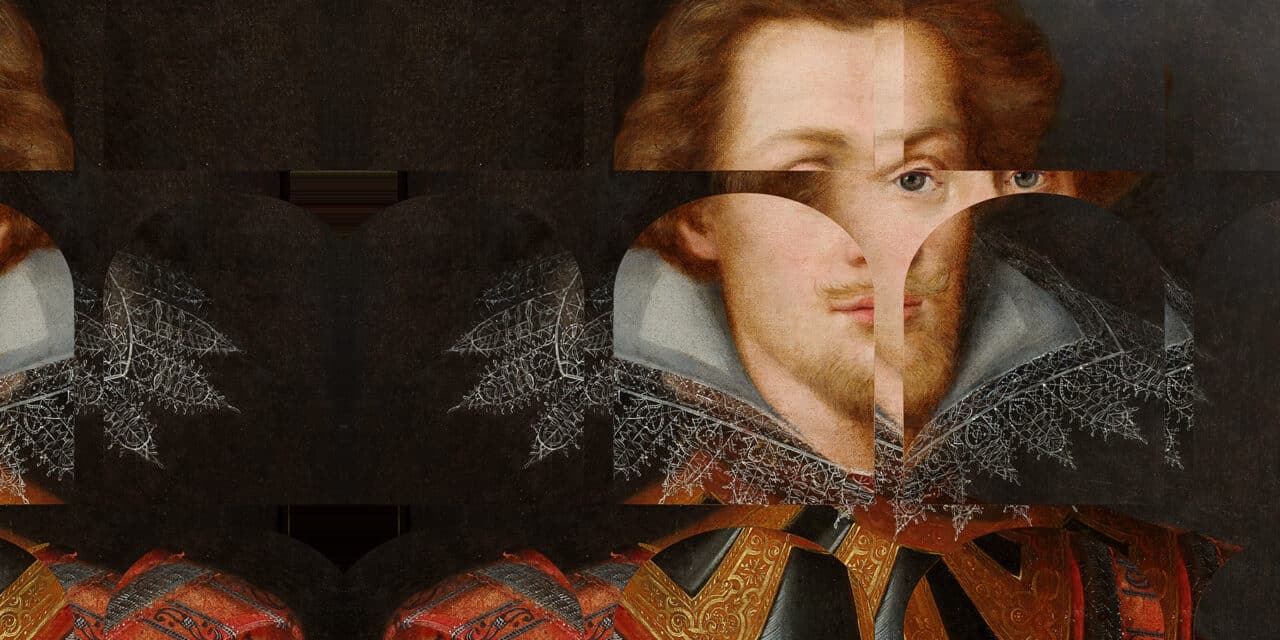
Ambition was a defining characteristic of the talented and determined first Prince Hans Ulrich von Eggenberg (1568-1634). As imperial governor of Inner Austria, the scion of a previously insignificant Styrian patrician family reached the pinnacle of an incredible career in 1625. In the same year, Hans Ulrich commissioned the construction of a new residential palace in Graz. 2025 marks the 400th anniversary of the start of construction and is the occasion for an extraordinary exhibition project. The building of the palace itself harbors a great deal of ambition. Hans Ulrich von Eggenberg had a Spanish-inspired royal palace built to express his good government as a political manifesto and symbolic utopia of peace and order. His descendants also perpetuated this illusion of a golden age, although the reality was determined by hardship and decay. To this day, the palace bears witness to the glory and honor of the Eggenberg family. The exhibition takes us back to the time of the Eggenbergs - a time of crisis and change, full of dangers but also full of opportunities. Their baroque palace is not a residence, but a huge theater stage. The court ceremonial takes center stage here. Eggenberg can also be read as a grand play. The state rooms and Planetary Hall take on their original role: they become stages for the grand staging of a princely family that has managed to turn its failure into an eternal success story with the help of a work of art. The STEIERMARK SCHAU at Schloss Eggenberg brings not only the locals but also the people who shaped the court before the curtain and tells of their lives.
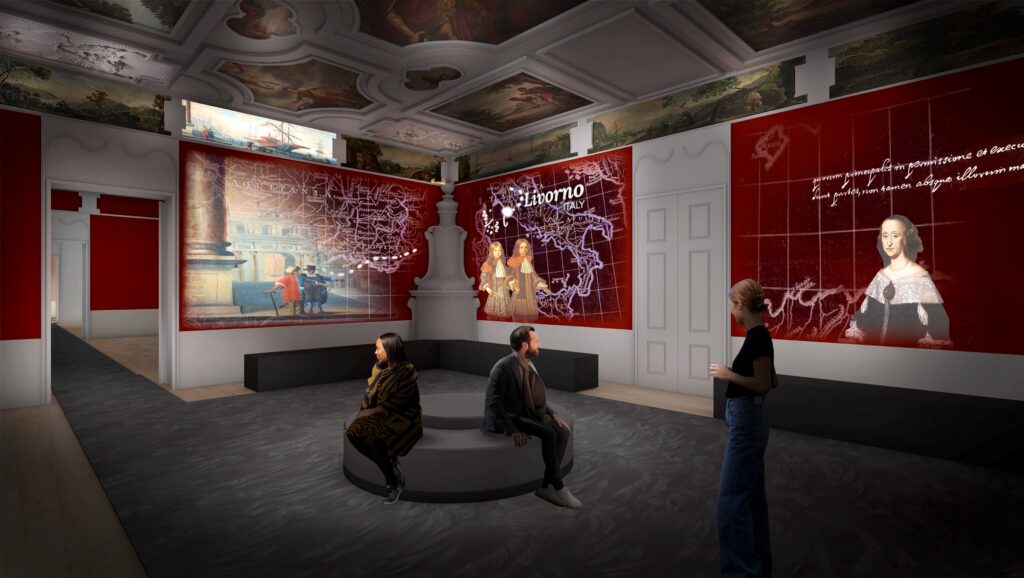
2025 STEIERMARK SCHAU shows Schloss Eggenberg in a new light. Graphics: Studio Louter
The Eggenbergs and the money
In 1625, Emperor Ferdinand II. Hans Ulrich von Eggenberg and his descendants the privilege of minting gold and silver coins with their own portraits and names. For just over 60 years, the Eggenbergs made use of their right to mint coins and produced ducats, talers, florins and groschen. Today, these coins are unique rarities. The Coin Cabinet has outstanding evidence of the minting activities of the Eggenbergs thanks to its collection history dating far back into the 19th century.
In the exhibition at the STEIERMARK SCHAU 2025, the rise, glory and decline of the Eggenberg dynasty will be presented using these coins. In addition, examples of the diversity of coinage in the Holy Roman Empire in the 17th century are presented.
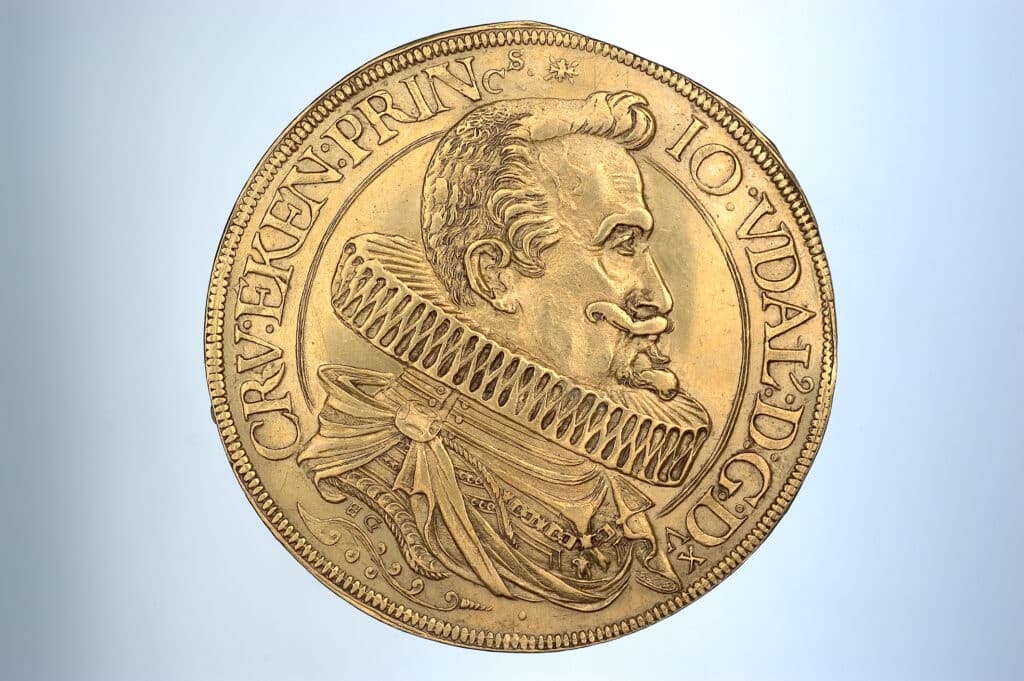
Hans Ulrich von Eggenberg, tenfold ducat, 1629, obverse, photo: Universalmuseum Joanneum/N.Lackner
Graz 1699
The special exhibition Graz 1699 at the Museum of Archaeology takes visitors back to the lively atmosphere of the city of Graz in the 17th century: The focus is on a digital reconstruction of Baroque Graz, based on historical copperplate engravings and enriched by selected archaeological finds from Graz city center and Eggenberg Palace.
The visualization will have a special recognition value for Graz residents: Some iconic buildings, such as those on Graz's main square, still exist today, while others have long since disappeared. This innovative presentation builds a bridge between the world heritage site of Schloss Eggenberg and the vibrant heart of the historic center of Graz. The exhibition allows visitors to experience part of the rich history of the provincial capital in a completely new, captivating way.
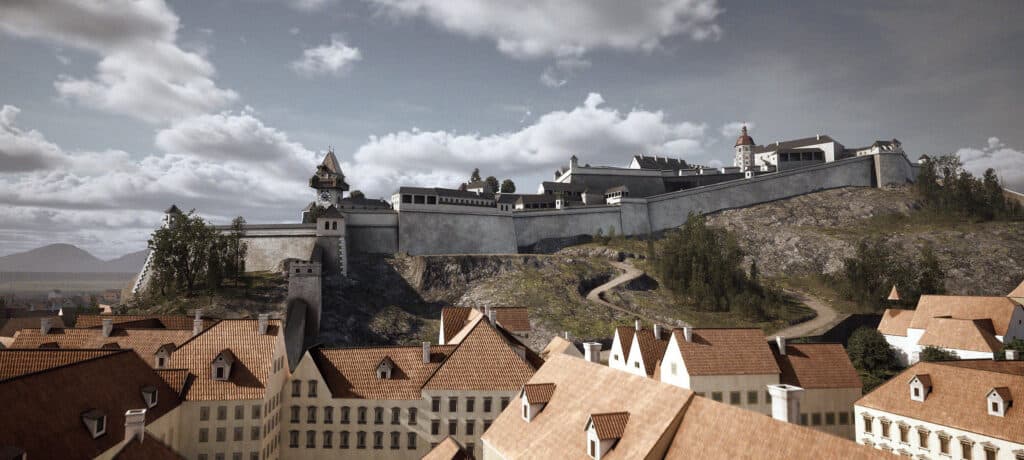
Digital reconstruction of the former fortifications on the Schlossberg in Graz, graphic: Universalmuseum Joanneum/I. Slamar
The three pavilions of STEIERMARK SCHAU 2025 History Repeating?
This year's STEIERMARK SCHAU will be accompanied by a total of three pavilions, which were on display at Heldenplatz in Vienna until the end of March 2025, before embarking on their journey to Styria and beyond its borders. The architectural concept comes from the Graz-based architectural group studioWG3, the exhibition entitled History Repeating? is curated by Günther Holler-Schuster and works by around 20 artists can be seen and heard. Looking back to the Baroque period and Schloss Eggenberg, the pavilions of STEIERMARK SCHAU pose the question of whether historical cycles of crisis are repeating themselves in the present: The exhibition History Repeating? picks up on the turbulent history of Schloss Eggenberg's origins, shaped by the Thirty Years' War, financial scandals and the Little Ice Age, and draws parallels with current global challenges such as armed conflicts, undesirable economic developments, increasing poverty and anthropogenic climate change. These parallels are taken up by the artists in their works in the three pavilions.
Music Pavilion - Baroque theatricality
Music plays a central role in the pavilion, which will be on display in Eggenberg Palace Park for the entire duration of the exhibition; architecturally, it echoes the baroque theatricality and aesthetics of the garden pavilion. The composer Klaus Lang has studied the music composed at the Eggenberg court and the emblems incorporated into the ceiling paintings of the palace. These emblems served to educate and edify the aristocratic youth and were therefore not only intellectual puzzles but also instructions for action. The idea behind Erwin Wurm's "One Minute Sculptures", or rather the performativity of his art, is fundamentally linked to baroque theatricality. Wurm's sculptures form an imaginary court society whose psychological disposition, however, seems to have been shaken.
April 26 to November 2, 2025 in Eggenberg Palace Park
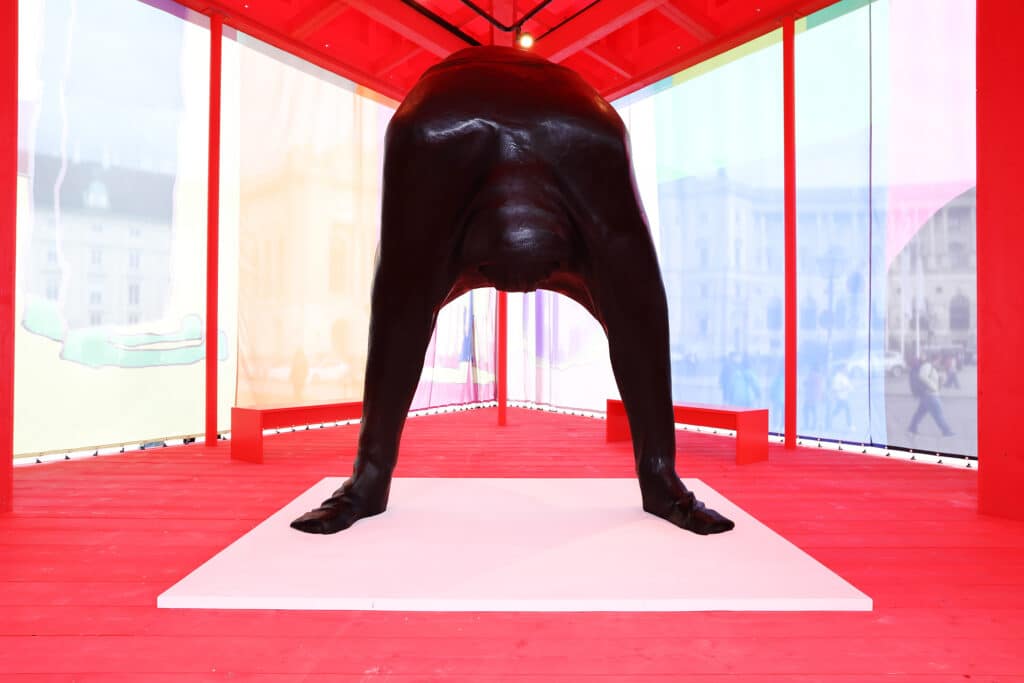
Erwin Wurm, Big Psycho (Psychos), 2010 in the Music Pavilion, Photo: Universalmuseum Joanneum/JJ Kucek © Bildrecht Wien, 2025
Styria Pavilion - tradition and modernity
A stylized mountain range symbolizes the topography of Styria. Herbert Brandl designed this in the tradition of panorama painting. The monumental painting leads the public to the beauty of the Alpine landscape, but also recalls the storms of the country's turbulent history. The two locations of this pavilion, Mariazell and Leoben, are situated in extensive woodland with pronounced forestry, to which works in the pavilions also refer. Constantin Luser's acoustic tree and his trumpet figures open up a cultural space in which the regional context is reflected in multiple ways. The duo Plateau Residue addresses the use of resources using the example of forestry. Karoline Rudolf and Antonia Jeitler deal with the form of presentation of the monument in their work. The plinth, which usually elevates and exposes the figure, becomes an unstable terrain in Rudolf's work, on which the artist resists the turbulence of reality. Jeitler's portraits of anonymous people who remain invisible in society bear witness to the fragility of the self-image and to the possibility of being exposed in an exposed place: the pedestal.
The confrontation between tradition and modernity is also repeatedly expressed in art - regional aspects against the backdrop of global reality. This is also visible in Mito Gegič's video work, in which a gigantic wrecking ball swings from one monitor to the other between two young people in folkloric dress. May 1 until July 28, 2025 in Mariazell
August 20 to October 31, 2025 in Leoben
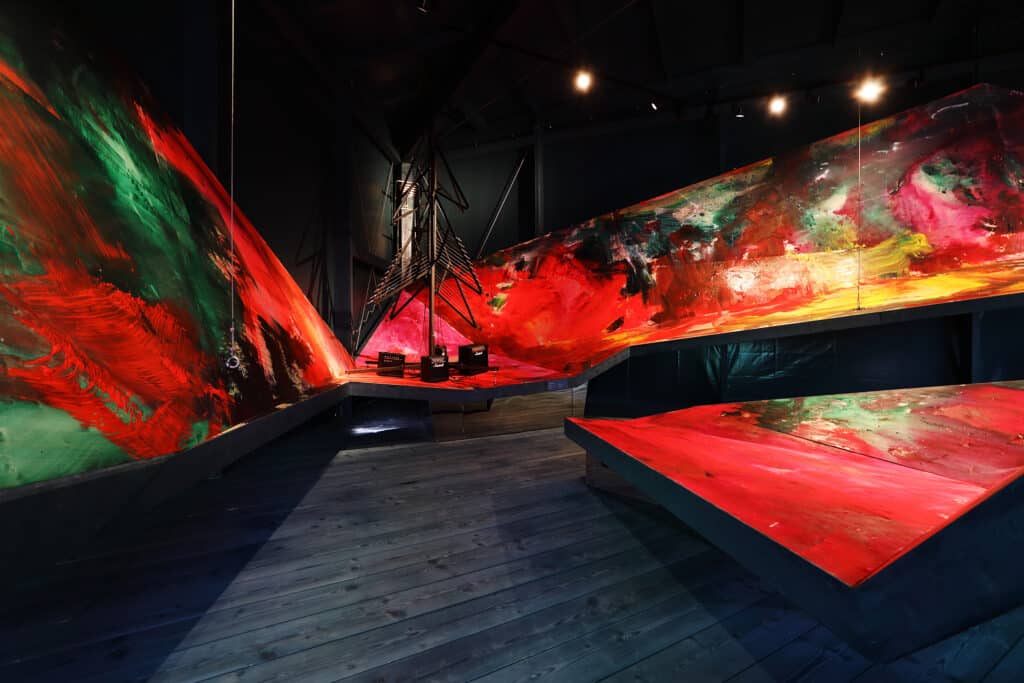
Styria Pavilion with Herbert Brandl, Mountains, 2025, acrylic on wood, 180 m2, Photo: Universalmuseum Joanneum/JJ Kucek
Alps-Adriatic Pavilion - Regional Identities
The Alps-Adriatic region is linked by a common history, but at the same time is characterized by historical conflicts that are difficult to reconcile. Until 1918 it was part of the Habsburg Monarchy, and after the Second World War it was the border region between Austria, Italy and Yugoslavia. The new geopolitical order after 1945 resulted in the territorial fragmentation of the region and the mutual demarcation of the people living in it. The architectural tripartite division of this pavilion also results from this history. The artistic contributions indirectly reflect the historical connection between Graz and "Inner Austria" and the "Trigon idea" of the 1960s by expanding the regional context and repositioning it in terms of cultural policy. Franz Kapfer explores the historical significance of the Styrian Panther and uses shadow play as an artistic medium to depict its symbolic transformation over the course of time. Christof Neugebauer restages mascarons photographically and acoustically so that the audience can communicate with them interactively - a playful examination of historical symbols of superstition. Milica Tomić uses geometric abstraction, inspired by statistical research, to visually reconfigure historical property relations in Styria (1938-1950). Total Refusal relates the baroque garden as a symbol of tamed nature to the aesthetics of modern video games and examines how historical ideals and digital game worlds influence each other. With her satirical Integration Center for Migrated Plants (IZMP), Lena Violetta Leitner reflects on global migration processes by staging invasive plants as a metaphor for social debates about adaptation and belonging. Michael Pöllinger combines nature, tradition and craftsmanship with contemporary issues to reinterpret problematic concepts such as homeland and customs. Andreas Heller uses architectural elements such as fences as sculptural objects to link historical formal language with current themes such as xenophobia, demarcation and isolation.
The Alps-Adriatic Pavilion travels to Ljubljana.

Exhibition view of the Alps-Adriatic Pavilion with Lena Violetta Leitner, IZMP showroom, 2025 (left) and sculptures by Andreas Heller (right)
Photo: Universalmuseum Joanneum/JJ Kucek © Bildrecht Wien, 2025
STYRIA SHOW
April 26 to November 2, 2025
www.museum-joanneum.at