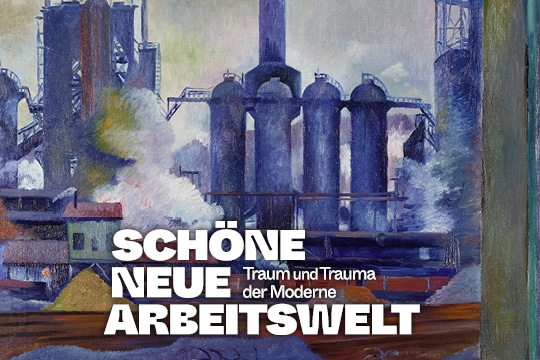
Work - it structures our lives, shapes our identity, secures our existence. But what happens when these familiar certainties begin to falter? When machines, algorithms and artificial intelligence question not only our activities, but also our notions of meaning and self? These questions are just as relevant today as they were a hundred years ago - and this is precisely where the major exhibition "Brave new world of work. The Dream and Trauma of Modernity" at the LVR-Landesmuseum Bonn.
At the beginning of the 20th century, society underwent a fundamental change: electricity, assembly line work, automation - industrial modernity fundamentally changed people's relationship to work. Art became a mirror, sometimes even a seismograph of these upheavals. Painters, sculptors and photographers observed, commented on, lamented or celebrated the transformation. They captured in color, form and material how machines became symbols of progress and at the same time symbols of alienation.
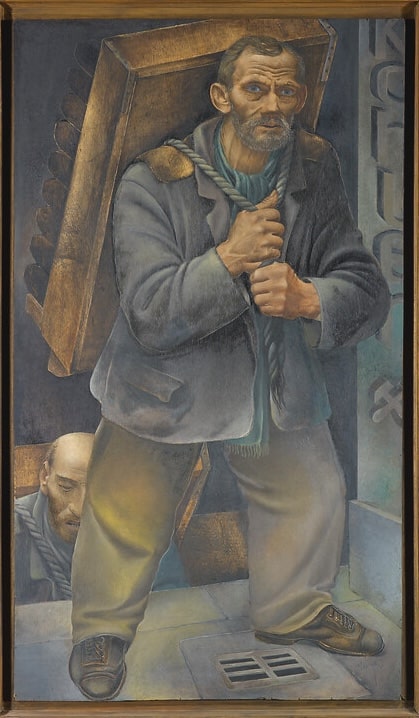
Leo Breuer, The Coalman, 1931, LVR-Landesmuseum Bonn, Photo: Jürgen Vogel © VG Bild-Kunst, Bonn 2025
In six thematically structured chapters, the exhibition traces the ruptures and aspirations of an era that oscillated between euphoria and exhaustion. Icons of New Objectivity such as Leo Breuer's monumental "Kohlenmann" (1931) are juxtaposed with Otto Dix's expressive figures or Conrad Felixmüller's socially critical visions. Hannah Höch's collages dissect the role models of working society, while Franz Wilhelm Seiwert's clear, geometric figures depict people as part of a new, mechanized order.
But it is not just the well-known names that make this show so appealing. Works by artists such as Sella Hasse, Thea Warncke and Magnus Zeller open up hitherto little-noticed perspectives. Their works give the world of work a different face - one that emphasizes the social and emotional dimensions of everyday life, that makes both hardship and dignity visible.
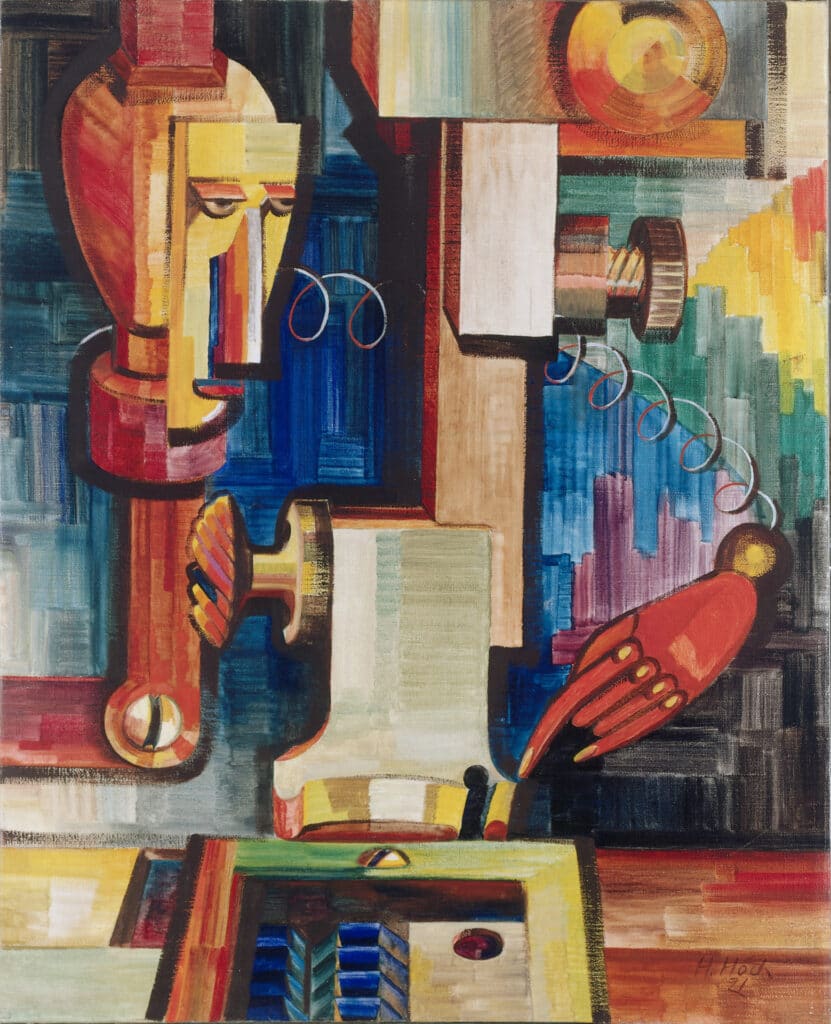
Hannah Höch, Man and Machine, 1921, Germanisches Nationalmuseum Nuremberg © VG Bild-Kunst, Bonn 2025
"Brave new world of work" is much more than a historical retrospective. The curatorial dramaturgy builds a bridge to the present: to home office, artificial intelligence and the discussion about the four-day week. Visitors can reflect on their ideas of a future working world in interactive areas. How do we want to live and work tomorrow? What dreams and traumas will accompany us into the future?
The exhibition is complemented by a current position: in her installation "Tracing Labor", artist Gertrud Riethmüller, winner of the Rhineland Art Prize 2024, impressively shows how traces of past working environments are inscribed in our present. Using material fragments, sounds and light, she creates spaces in which the past and the future meet.
In this way, the LVR-Landesmuseum Bonn becomes a resonating space for a question that never loses its topicality: What does work mean - then, now, tomorrow? Between dream and trauma, a narrative unfolds that shows that people are always more than what they do.
November 13, 2025 to April 12, 2026
https://landesmuseum-bonn.lvr.de
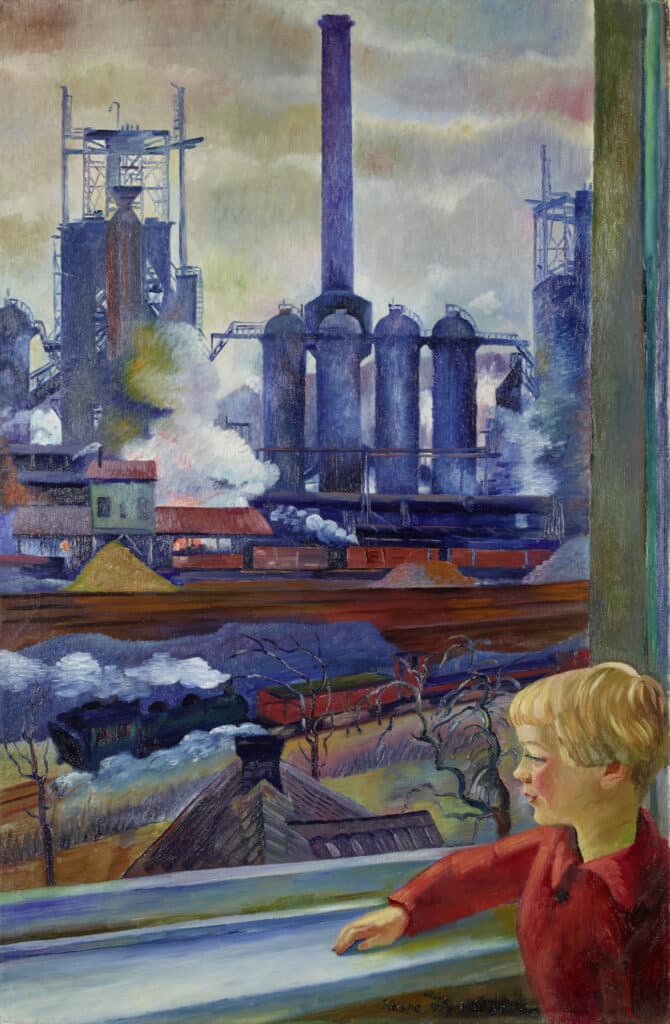
Conrad Felixmüller, Child in front of a blast furnace, 1927, LVR-Landesmuseum Bonn, Photo: Jürgen Vogel © VG Bild-Kunst, Bonn 2025