
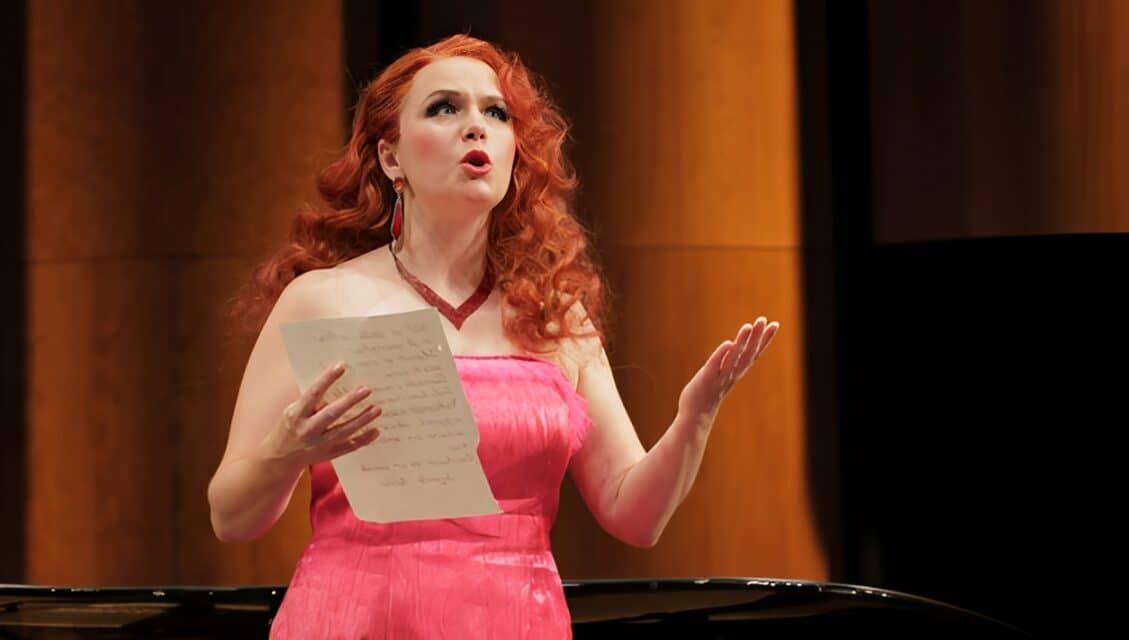
Memory, loss, and the search for truth: The chamber opera "The Elephant in the White Sea" tells the story of a young woman who sets out to find her missing great-grandfather—and in doing so uncovers the repressed chapters of the history of Stalinism.
The chamber opera "The Elephant in the White Sea" centers on Liza Switlytschna, who wants to learn more about the fate of her great-grandfather, who disappeared without a trace in the 1930s. Her only possible source is her grandmother, whose memories, however, are increasingly clouded by dementia. Despite the fragmentary narratives, Liza tries to reconstruct her family's history.
Her research ultimately leads her to Sandarmoch in the forests of Karelia—a place where thousands of victims of the so-called Stalinist purges lie buried in mass graves. There, historian and human rights activist Yuri Dmitriev discovered the remains of numerous murder victims. What begins as a personal search for clues develops into an examination of a collective trauma: the "Great Terror" of the 1930s.
Yana Shliabanska's music creates a dense, intimate atmosphere in a chamber music setting. Voices often emerge quietly and fragmentarily, scenes arise in confined, concentrated spaces. This creates a tonal closeness that immediately draws the audience into Liza's journey down memory lane.
Ukrainian director Anastasiia Vervejko developed the concept and libretto for the opera. For her, "The Elephant in the White Sea" is a work about memory—about the impossibility of permanently repressing history and about the responsibility to confront the past. The search for a single person thus gives rise to a haunting musical theater piece about memory, loss, and historical truth.
Premiere May 15,
Further performances: May 16 and 29, June 5, 2026