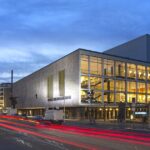
A striking jewel of post-war modernism, the Theater Münster on Neubrückenstraße was the first new theater to be built in Germany after the Second World War in 1956. It was built on the ruins of the previous building and visibly integrates fragments of the historic Romberger Hof.
The architectural design was created by young post-war planners: Harald Deilmann, Max von Hausen, Ortwin Rave and Werner Ruhnau. The building impresses with a nested concrete and glass structure with a paraboloid stage tower, elegant open staircases and delicate supports - an expression of sensitive modernity.
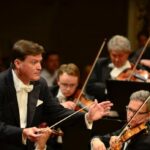
Norbert Kricke's dynamic space-time sculpture has been hovering above the main entrance since the opening in 1956: an airy structure made of bent steel wire that carries the future into the present. The ensemble offers a variety of performance formats: in the large house with around 900 seats, a small house with around 300 seats since 1971 - including the "U2" studio stage in the basement with around 50 seats. In one season, up to 30 premieres and around 600 performances are on the program, as well as around 80 concerts by the Münster Symphony Orchestra.
A particular highlight is the International Jazz Festival, which takes place every two years and transforms the building into a stage for global sounds, attracting music enthusiasts from all over the world.