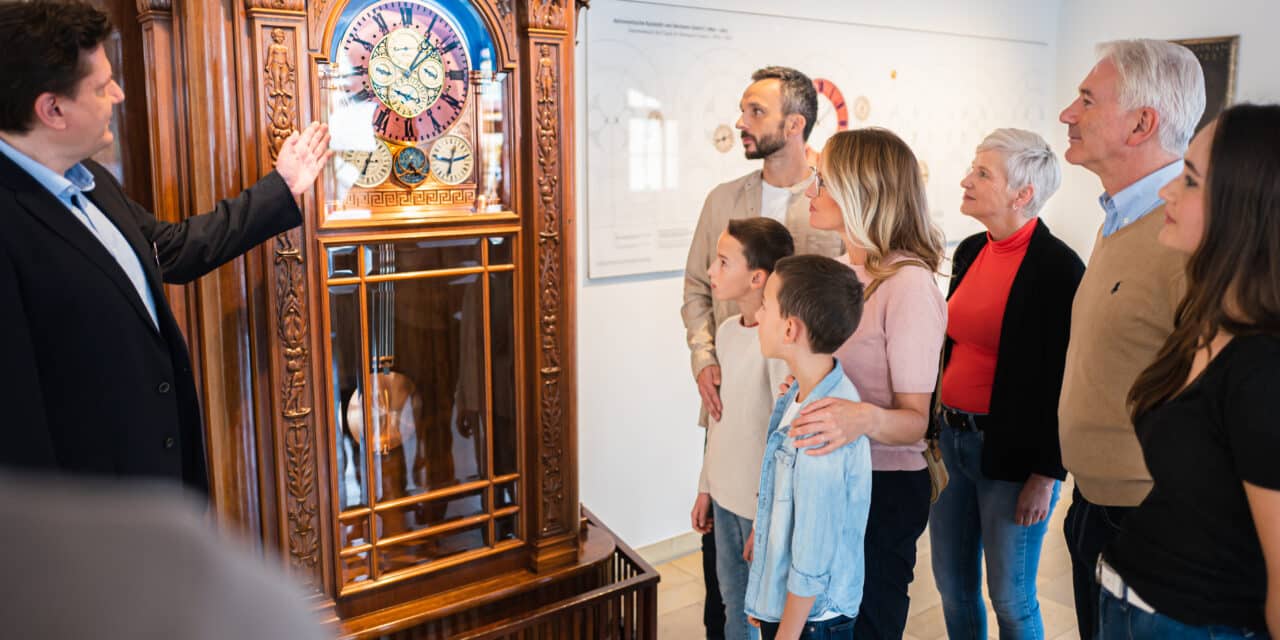
In a world where time seems omnipresent but often fleeting, an extraordinary anniversary invites us to pause and reflect on the art of measuring time: Hermann Goertz's Astronomical Art Clock is 100 years old this year. It stands at the center of the German Watch Museum Glashütte - an institution that is an impressive monument to the 180-year watchmaking tradition of the small Saxon town. After just a few steps, visitors to the museum are confronted with a colossal masterpiece that combines mechanical sophistication and aesthetic finesse in a unique way. To mark the anniversary, the special exhibition "ZEITSPRUNG " will be dedicated to this unique clock from September 11, 2025.
The Astronomical Art Clock is not just a timepiece, it is a cosmos in miniature. With its 1,756 individual parts - including 122 gear wheels, 54 levers and 424 screws - it represents a technical and artistic achievement that is almost unthinkable today. Eight dials, 17 hands and 20 different displays provide far more than just hours and minutes: the movement of the moon, the age of the moon, sunrise and sunset times, a perpetual calendar and even the visible starry sky over Glashütte are also shown here. A striking mahogany case with striking mechanism rounds off the overall work of art.
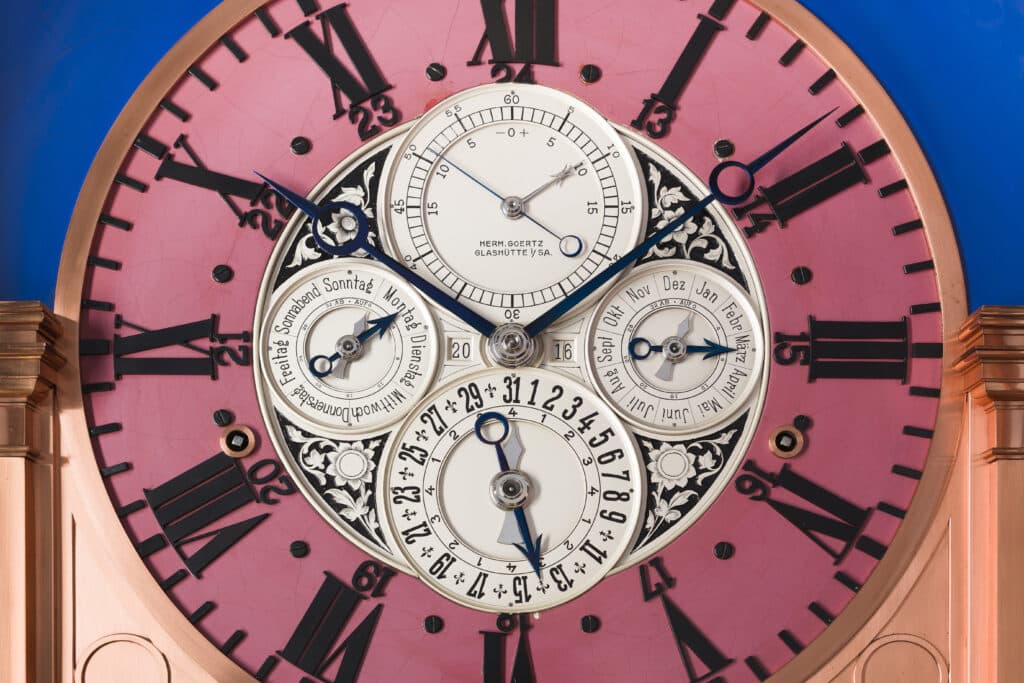
The display-rich dial, photo René Gaens
The clock was built by Hermann Goertz, a watchmaker of West Prussian origin - a man whose life story is as unusual as his creation. Trained in Berdyansk and later self-employed in Kharkov, he experienced the turmoil of the Russian Revolution at first hand. He fled to Germany in 1918, found a new home in Glashütte - and made watchmaking history there. At the age of 56, he enrolled at the German Watchmaking School in Glashütte to complete his work on the art watch. On October 17, 1925, the time had come: after more than 30 years of construction, he declared his "great clock" complete.
Three years later, the Free State of Saxony acquired the movement and handed it over to the watchmaking school as a teaching aid. It has been beating and running ever since - with impressive consistency and precision, interrupted only by careful revisions. The watch is not only a testament to technical mastery, but also a symbol of the perseverance and dedication with which watchmakers like Goertz practiced their craft.
To mark the 100th anniversary of the Astronomical Art Clock, the Clock Museum opened a special exhibition dedicated to the art clock in September 2025. Entitled ZEITSPRUNG, the exhibition takes visitors on a journey back in time to 1925, when the clock was completed. Various themes are used to bring the technical and social conditions of the time to life and show the challenges Hermann Goertz had to overcome while working on his masterpiece. The exhibition also provides vivid insights into the interior of the clock. The perpetual calendar, the astronomical functions and the materials used in the construction of the clockwork have been selected as central elements. The new special exhibition can be viewed during the regular opening hours of the clock museum, Wednesday to Sunday from 10 am to 5 pm.
www.uhrenmuseum-glashuette.com
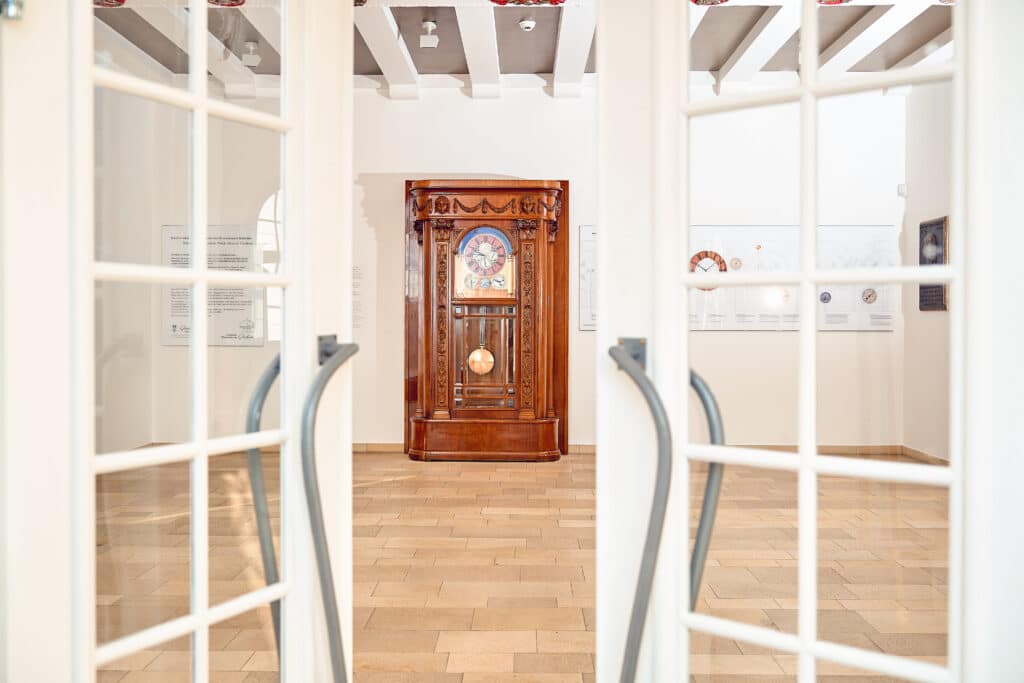
Astronomical art clock, photo René Gaens