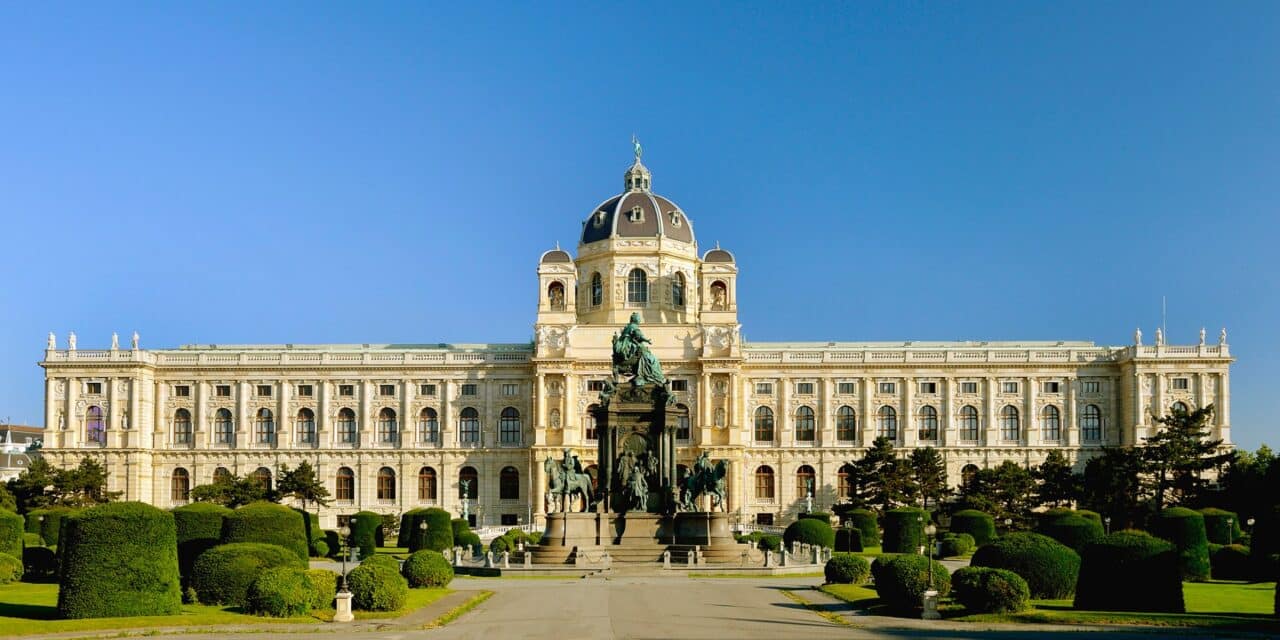
The Natural History Museum Vienna (NHM) is one of the most important natural history museums in the world. Located on Maria-Theresien-Platz, it impresses not only with its magnificent neo-Renaissance architecture, but also with its extensive collections of over 30 million objects.
The Natural History Museum Vienna preserves, expands, researches and presents its extensive biological, earth science, anthropological, archaeological and cultural science collections in a building designed as a Gesamtkunstwerk. It conveys the diversity of nature, the evolution of planet Earth and life as well as the associated cultural development of mankind and offers an inspiring meeting place where evidence-based communication as well as dialog and exchange between science and society take place.
Around 100,000 exhibits are presented on around 8,460 square meters of exhibition space. Highlights include the world-famous Venus of Willendorf - one of the oldest depictions of man - and the impressive meteorite collection, one of the largest and oldest of its kind. A special highlight is the dinosaur hall with life-size models and skeletons of dinosaurs, including an animated model of an Allosaurus, which impressively illustrates the movements of this prehistoric predator.
The aim of the Natural History Museum Vienna is to make a significant contribution to sustainable development in Austria, Europe and the world. We want to achieve this through our excellent disciplinary, interdisciplinary and participatory research, through the digital opening of our collections, through innovative, inclusive and inspiring approaches to science communication and public relations and through the implementation of a barrier-free and CO2-neutral museum.
In 2024, the NHM had around 971,000 visitors, making it one of the most visited cultural institutions in Austria.