The Museum Reinhard Ernst in Wiesbaden invites you to a special encounter with the legendary American painter Helen Frankenthaler. Under the title "Helen Frankenthaler moves Jenny Brosinski, Ina Gerken, Adrian Schiess", the three contemporary artists open up a fascinating dialog between past and present. The exhibition shows thirteen works by Frankenthaler from the Reinhard Ernst Collection, including seven previously unseen works, which are set in relation to new positions in abstract painting from Germany and Switzerland.
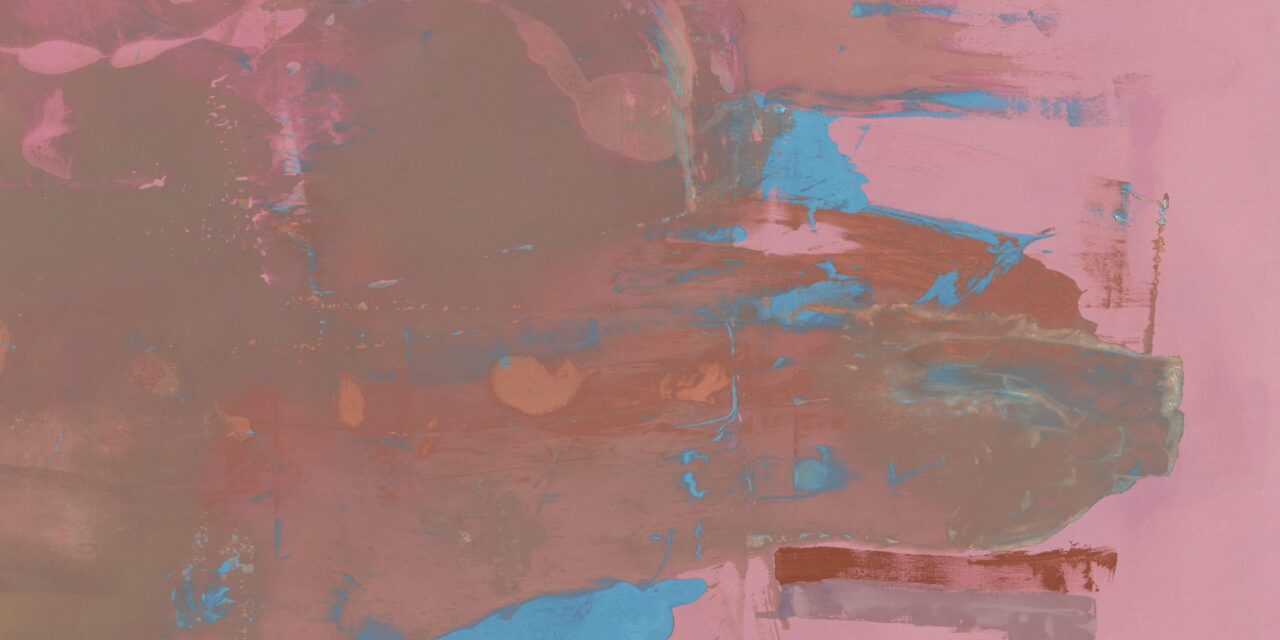
Jenny Brosinski picks up on Frankenthaler's joy of experimentation and willingness to take risks. Apparent accidents and spontaneous impulses play a central role in her painting process. Works are created on unprimed canvas in which every brushstroke remains visible and the openness of the composition breathes Frankenthaler's spirit. Brosinski's works often begin on the floor and are later raised to combine playfulness with conscious decisions - a process that demands freedom and control at the same time.

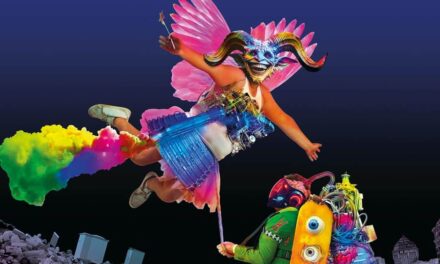
Jenny Brosinski, What it is (Sunny Side up), 2017/18, oil, charcoal, acrylic, fabric on canvas, photo: Holger Niehaus © VG Bild-Kunst, 2025
Ina Gerken moves through the painting process in a similarly intuitive way. Expressive painterly gestures meet flowing color as the artist works sometimes on the wall, sometimes on the floor. Her works thrive on the non-resistance of the paint, on the ability to let go of control and fully engage with the moment. Frankenthaler's lightness and conciseness inspired her to abandon herself to the color and allow the painting to act as an independent force.
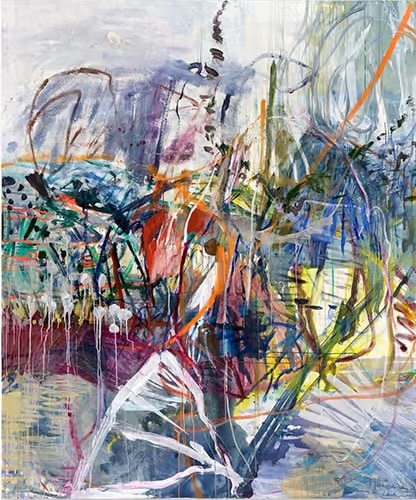
Ina Gerken, Scales, 2023, acrylic, oil pastel on canvas, photo: A.R. © Courtesy of the artist
Finally, Adrian Schiess explores the dissolution of painting's boundaries in space and time. Since the 1980s, the Swiss artist has been experimenting with large-format lightweight panels that are given a reflective surface through industrially applied layers of paint. His works oscillate with light and movement, changing in the viewer's gaze and refusing any fixed perspective. In Wiesbaden, these smooth, reflective surfaces enter into an exciting dialog with Frankenthaler's expressive color surfaces, which transfer dynamism and fluidity into the space.
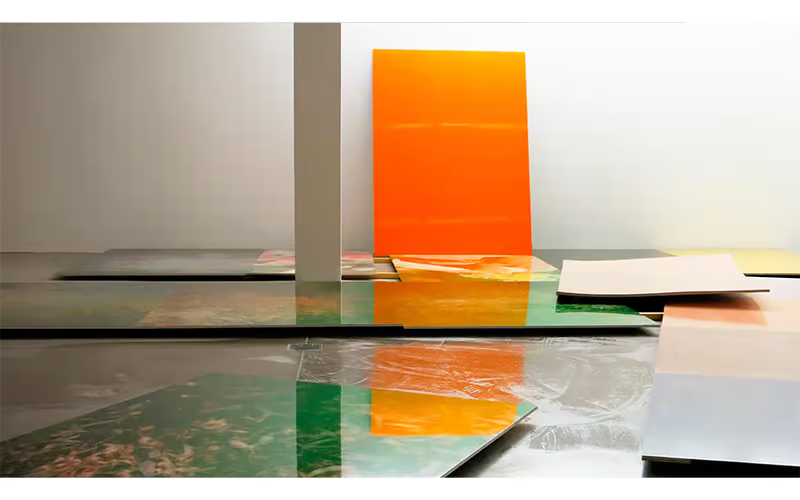
Adrian Schiess, Exhibition view, Painting 1980─2020, Kunstmuseum St. Gallen, 2021, Photo: Stefan Rohner © Kunstmuseum St. Gallen
The central venue of the exhibition is Room 3, the highest room in the museum with a ceiling height of 14 meters. This is where all four positions - Frankenthaler's pioneering spirit, Brosinski's openness, Gerken's intuition and Schiess' spatial staging - meet and unfold an interplay of control, chance and flowing movement. A further room on the second floor is dedicated to Frankenthaler's monograph, so that her works have an effect both in dialog and in independent perception.
The exhibition offers a rare opportunity to experience Helen Frankenthaler's impact on the present, while also providing an insight into the world's largest private collection of her works. It combines history, inspiration and contemporary positions to create a multifaceted art experience that invites visitors to rediscover color, space and composition.
October 26, 2025 to February 22, 2026
www.museum-re.de