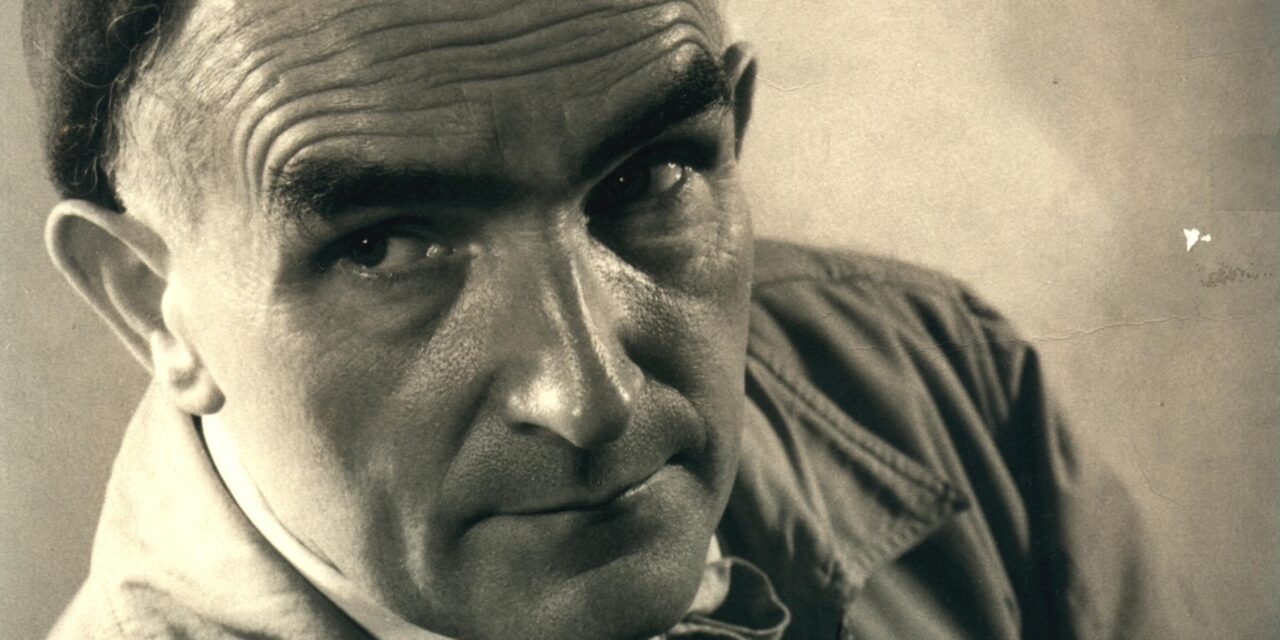
Luis Rauschhuber (1904–1973) is one of the most important, yet today largely forgotten, sculptors of the 20th century in Nuremberg. While many of his contemporaries are still regularly featured in exhibitions and publications, his extensive body of work has fallen into oblivion—an imbalance that his daughter Monika Nagel and granddaughter Johanna Junold are now correcting. On June 1, 2025, they opened Rauschhuber's studio and home at Königsbergerstraße 49 in Ziegelstein as a private museum. Here, visitors gain direct insight into the life and work of an artist whose works shaped the cityscape of Nuremberg for decades.
Rauschhuber's works are known above all for their quiet, contemplative power. His sculptures—large and small, freestanding and wall-mounted—can be found in numerous locations throughout Nuremberg. From the stone crucifix at the entrance to St. John's Cemetery to the "Die Schreibende" (The Writer) sign on the Nürnberger Presse publishing house, to the sandstone friezes in the courtyard of the South Tax Office, to the sgraffito "Beruf und Handwerk" (Profession and Craft) on the parapet of the town hall—Rauschhuber's work is subtle but omnipresent. These works reveal his deep religiosity as well as his interest in the human figure, everyday life, and the urban culture of his hometown.
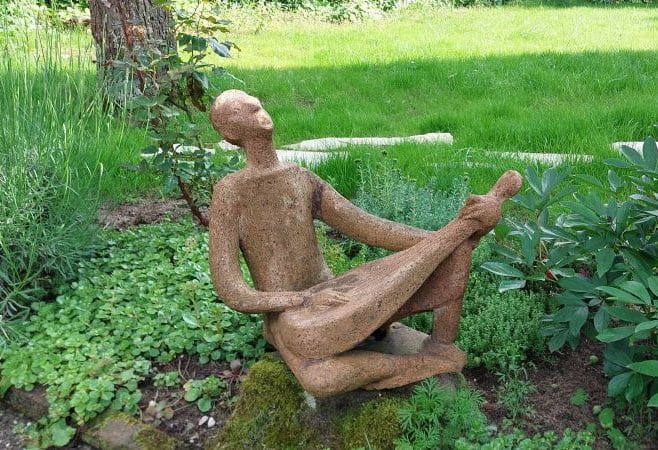
Lute player by Luis Rauschhuber in the garden of the studio house. Photo: Alexandra Foghammar
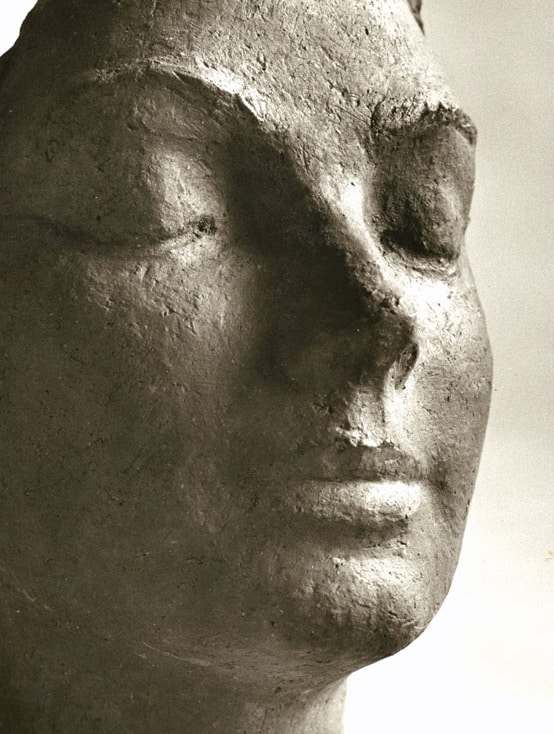
Born in Upper Bavaria, Rauschhuber grew up as an orphan and earned his living as a teenager building canals on the Inn River. In 1924, he moved to Nuremberg, where he discovered his love of architecture and sculpture and completed an apprenticeship as a stonemason. At the same time, he attended evening classes at the State School of Applied Arts and won prizes and awards for his work at an early age. From 1930 to 1933, a scholarship enabled him to study at the Academy of Fine Arts in Munich under Karl Killer. His admission work, the "Man of Sorrows," can still be seen today as a war memorial in St. Martin's Church. After returning to Nuremberg, Rauschhuber worked as a freelance sculptor and quickly gained public attention, particularly for his portraits.
Luis Rauschhuber © Rauschhuber Studio House
The Second World War brought severe setbacks: his studio was destroyed twice and he also lost his home. In 1944, he married Gertrud Meixner, and after the war ended, the couple returned to Nuremberg. In the 1950s, his children Monika and Martin were born, and Rauschhuber created an extensive body of work consisting of sculptures, portraits, and drawings in his studio house in Ziegelstein. He was in lively exchange with painters, architects, musicians, poets, and theater people. His friendship with the painter Eitel Klein was particularly influential. Many of his major commissions, including religious themes, mother-child depictions, angels, and Pietà, can still be seen in Nuremberg today. His last major sculpture, "Der leidende Mensch" (The Suffering Man), was created in 1971 and stands in the Nuremberg North Clinic.
Rauschhuber's style remained unmistakable throughout his life: a clear formal language paired with sensitive expressiveness, heartfelt emotionality, and a strong connection to materiality. The major changes in the art scene in the 1960s and 70s had little effect on him; he remained true to his own artistic ethos, even if this diminished public perception. He died in Nuremberg in 1973, but his works live on—not least in the new studio house, which is open to visitors every Sunday from 1 p.m. to 4 p.m. and offers insights into the creative life of a sculptor whose art continues to touch and resonate to this day.
Sundays from 1 p.m. to 4 p.m.
www.atelierhaus-rauschhuber.de
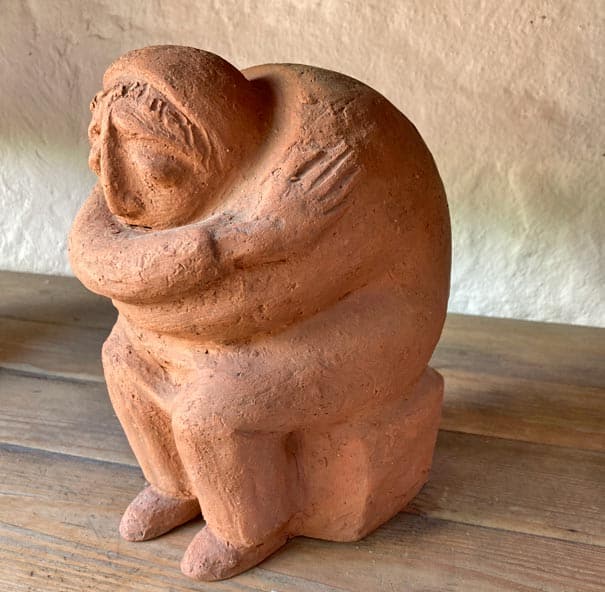
Design for the large sculpture "The Suffering Man" for the Nordklinikum hospital, patinated terracotta, around 1972. Photo: Alexandra Foghammar