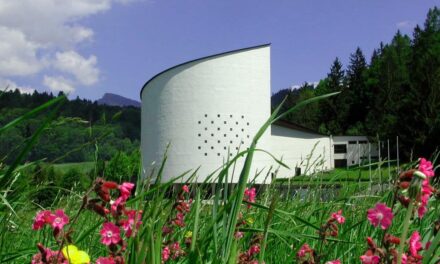
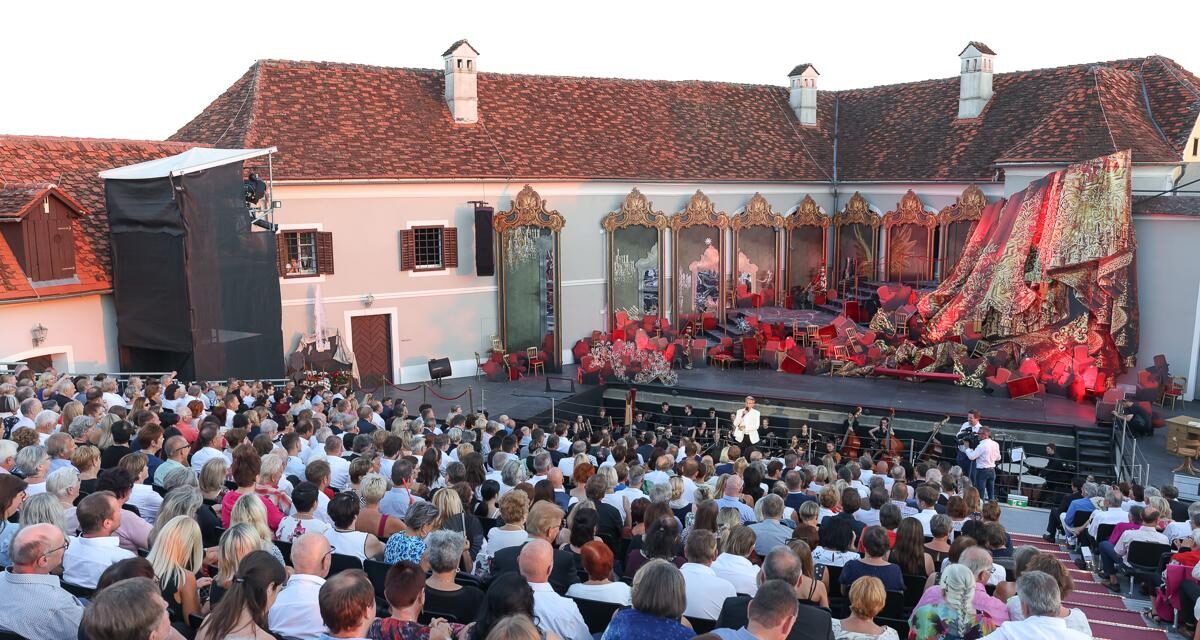
Anyone attending the festival at Tabor Castle in summer 2026 will be visiting a place where landscape, history and art merge into a rare unity. Hardly any other venue in southern Burgenland has such a poetic aura as the castle located in the middle of the trilateral Raab-Őrség-Goricko Nature Park. Surrounded by rolling hills and centuries-old border lines between Austria, Hungary and Slovenia, it is one of the oldest buildings in the district of Jennersdorf - a historical gem whose roots go back to the 15th century.
The village was first mentioned in 1469, when the mercenary leader Ulrich Pesnitzer had a fortification built here. Today's castle, however, was first built by the influential Hungarian noble family Batthyány in the 17th century, who turned Tabor into the administrative center of their widely ramified dominion. Residing mainly in Vienna, the family only used the palace sporadically, but their handwriting has had a decisive influence on the character of today's building. After the turmoil of the Second World War, when the building briefly served as a tank workshop, Tabor was transformed into a residential and later a cultural site.
A new era began when it was taken over by the Raab Nature Park: under the management of JOPERA Jennersdorf, Tabor Castle was developed into an opera venue with a reputation that extends far beyond the region. Today, the ensemble is owned by the province of Burgenland, while the KulturRaum Schloss Tabor association - formerly JOPERA - continues to manage events such as the popular Advent festival, children's and youth programs and the historical exhibition. The castle thus remains a lively cultural space that effortlessly combines tradition and the present.
Viennese blood - waltzing bliss in the open air
Against this impressive backdrop, a work will unfold in August 2026 that embodies Viennese joie de vivre, humor and musical elegance like no other: Wiener Blut. The "comic operetta" based on Johann Strauss' son - artfully arranged by Kapellmeister Adolf Müller junior and with a libretto by Victor Léon and Leo Stein - is a piece full of lightness and esprit.
Strauss himself was no longer able to compose a new stage work due to his health. But the librettists' insistence had an effect: Müller junior selected more than 30 compositions by the king of waltzes and wove them into a potpourri in which much sounds familiar and yet sparkles in a new way. Waltz classics such as "Wiener Blut", "Morgenblätter" and the polka "Leichtes Blut" drive the plot forward and give it that irresistible mixture of elegance and verve that still characterizes the piece today.
The story, set at the time of the Congress of Vienna, unfolds in an amusing carousel of amorous entanglements. Count Zedlau, torn between duty, passion and social expectations, becomes entangled in a web of mistaken identities and misunderstandings. But as befits an operetta, the labyrinth ultimately leads to a happy ending - and to three-four time in the heart.
After an initially subdued premiere in 1899, Wiener Blut developed into an internationally acclaimed success with audiences from the 1905 reworking. Today it is considered one of the most radiant jewels of the classical operetta repertoire - and at Tabor Castle it takes on a special dimension: where historic walls warm the summer evening and nature frames the stage, Strauss' music unfolds its full magic.
August 5 to 16, 2026
www.schlosstabor.at
The whole world is sky blue, 2025 © Renate Schwarzmüller