With the presentation of STRIP TOWER (962), the Luma Foundation is realizing an extraordinary project in public space: a monumental open-air sculpture by Gerhard Richter, installed on Lake Silvaplana in Sils Maria. For an initial period of three years, the work will be accessible in one of Switzerland's most culturally and ecologically striking alpine landscapes – and, as part of Elevation 1049, will expand the geographical and conceptual radius of this long-term art project.
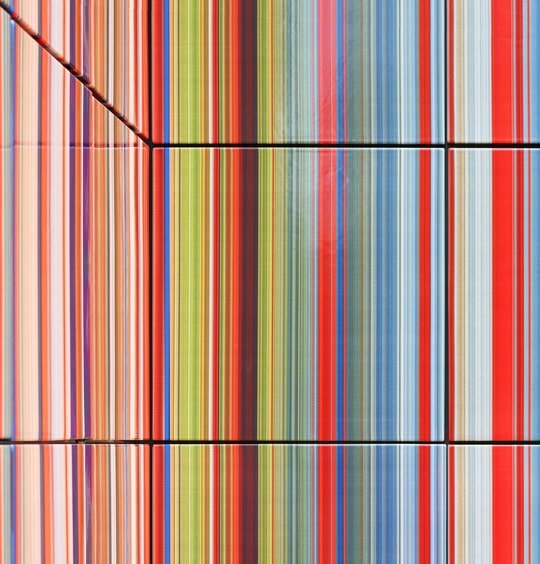
STRIP TOWER (962) translates Richter's more than six decades of engagement with painting, photography, abstraction, and digital image processes into three-dimensional space. The starting point is the series of Strip Paintings (from 2010), which in turn goes back to the squeegee-drawn Abstract Painting (724-4) from 1990. In the sculpture, the digitally processed horizontal stripes of color are transformed into eight vertical panels covered with glazed, colored ceramic tiles.
Over five meters high, the panels intersect to form a cross-shaped interior space that visitors can enter. Color, light, and reflection converge here to create an immersive experience. Seeing becomes a spatial practice: movement, changes in perspective, and temporal shifts determine perception. Instead of imposing itself on the landscape, the STRIP TOWER acts as an instrument of attention—it frames light, intensifies color, and sharpens the eye for the interplay between the work and its surroundings.
The sculpture unfolds its special resonance particularly in the Engadin. The changing alpine light, the climate, and the scale of the landscape become part of the work without dominating it. As Maja Hoffmann, founder and president of the Luma Foundation, emphasizes, STRIP TOWER combines "conceptual rigor, formal clarity, and material precision" and reaffirms the Alps as a place of serious cultural production. The installation exemplifies an understanding of art that combines public participation, sustainable reflection, and responsibility toward the location.
Sils Maria is also a familiar place for Gerhard Richter himself. He has returned regularly to the Engadin since his first visit in 1989. The crystal-clear light, striking topography, and contemplative atmosphere are closely related to his lifelong interest in repetition, chance, reflection, and the instability of visual certainty. In STRIP TOWER (962), these questions are articulated in a form that is both monumental and quiet—present without being loud.
The sculpture understands art as a public experience that unfolds over time. In a place traditionally associated with retreat and contemplation, Richter's work invites slow, repeated viewing. Its presence points to how art can deepen perception and sharpen awareness of ecological connections—not through illustration, but through experience.
With Elevation 1049, the Luma Foundation has established the Swiss Alps as an active intellectual and ecological field for contemporary art since 2014. Site-specific works—temporary, permanent, or episodic—engage with geography, climate, history, and global issues while promoting exchange between regions, languages, and perspectives. The fact that contemporary art can flourish beyond institutional spaces is particularly impressive in the alpine context.
True to its two-year rhythm, Elevation 1049 will return to Gstaad and the Saanenland in early 2027. With the appointment of Mohamed Almusibli, director of Kunsthalle Basel, as curator of the upcoming edition, the project underscores its ongoing commitment to site-specific, transformative works in the Alpine region.
Gerhard Richter
STRIP TOWER (962), 2023
Sils Maria, Lake Silvaplana
January 27, 2026 to spring 2029
www.elevation1049.org